Design Case Study
Word Rush
In Progress
Fast-Paced Word Game | Design & Development
Four required letters, thirty seconds, and a choice between finding longer words and keeping submissions moving.
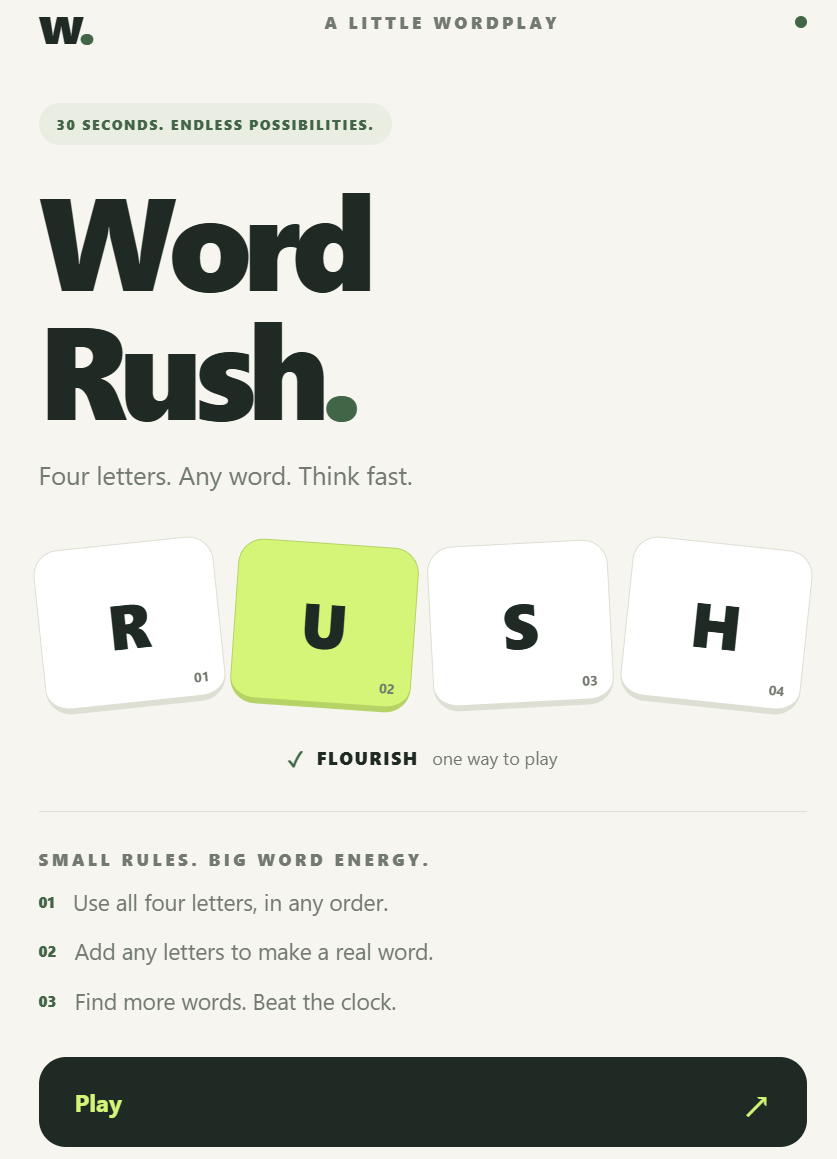
Overview & My Role
I designed and built a word game in which players have 30 seconds to submit as many valid English words as possible using four required letters. Valid words earn points, with bonuses for factors such as length and speed. Duplicate submissions are rejected.
Core Design Problem
How can four required letters create a useful challenge without making valid words frustratingly difficult to discover?
Rule Design
Letters may appear in any order
The challenge is to recognize words containing the letters, rather than solve a fixed sequence. Players can approach the same set through different vocabulary associations.
Additional letters are allowed
The solution space extends beyond four-letter anagrams. Short familiar words and longer discoveries can both contribute to a round.
Scoring: Length vs. Momentum
Length and speed bonuses create competing incentives. Searching for a longer word can increase its value, but spending time searching means fewer chances to submit. Quick words maintain momentum; longer words offer another route to score optimization.
The 30-second limit makes that tradeoff immediate. These are design intentions, not measured conclusions from user testing.
Feedback That Supports the Next Round
During play
Instant validation clarifies whether a word meets the rules. Duplicate rejection encourages fresh answers instead of rewarding repetition.
After play
The results show the score, accepted words, longest word, and common words the player missed. This makes the round’s outcome readable and gives concrete examples to carry into another attempt.
Useful missed words
The missed-word system avoids flooding results with repetitive plural and tense variations. The goal is to surface distinct, recognizable examples rather than an overwhelming list of near-duplicates.
What I Would Evaluate Next
Future playtesting could examine how often players find an initial word, whether speed and length bonuses are understandable, and whether missed-word examples help them approach the next round. No player-testing results are claimed here.
Technical Implementation
The implemented systems handle the round timer, required-letter checks, English-word validation, duplicate detection, scoring, and post-round summaries. Missed-word filtering supports the feedback design by reducing repetitive word variants.